 Leak Fix Pros
Irrigation and Yard Leak Detection in Whittier
Outdoor leaks waste water quietly. A cracked sprinkler line or a failing service line can run for weeks under a lawn before anything surfaces.
Short answer: Outdoor leaks are found by separating the irrigation system from the house line. Turn off irrigation and all indoor water, check whether the meter still moves, then test the irrigation zones and the buried line from meter to house with listening equipment. Wet, unusually green or sunken ground often marks the area.
Three kinds of outdoor leaks
Not every outdoor leak is the same problem, and the answer to who fixes it differs:
- Irrigation leaks: broken heads, cracked risers, failed valves or damaged zone lines. These only leak when the system runs, and zones are tested one at a time.
- Service-line leaks: the buried line running from the water meter to your home. It leaks all the time under pressure and moves the meter even with every tap off.
- Hose bib and exterior fixture leaks: leaks at outdoor faucets and the pipe stubs behind them, which can leak into the wall.
Ownership matters. In general the water utility owns the line up to the meter and the property owner is responsible for the line on the house side, but utilities and properties differ, so confirm with your water utility before assuming who pays for a repair.
How to tell what you have
- Stop all indoor use
Close taps, make sure no toilet is running, and stop dishwashers and washers. - Turn off irrigation
Switch the controller off or set it to rain mode so no zone starts during the test. - Read the meter
Look at the leak indicator on the meter or note the dial reading, then check again after the waiting period your utility recommends. - Interpret the result
If the meter moves, water is leaking somewhere on the property under pressure. If it is still, a leak is likely on the irrigation side or a drain, and zones can be tested one at a time.
This sorting step is the same one used for a high water bill investigation, and it saves time because it tells the provider whether to test the house, the yard or both.
Signs of a yard or irrigation leak
- Soggy ground, mud or standing water on dry days.
- A strip of grass that is greener or lusher than the rest.
- Sprinkler heads that mist, geyser, or deliver weak spray.
- Pressure that drops in the house or at hose bibs.
- Sinkholes, sunken pavers or cracked concrete near a line.
- A summer water bill that is far above what your landscaping would normally use.
- Moisture or staining on the exterior wall near a hose bib, which can point to a leak inside the wall; see hidden wall leak detection.
The U.S. EPA notes that outdoor leaks, such as irrigation systems damaged by freezing or worn hose washers, are a common household source of lost water.
What the provider does
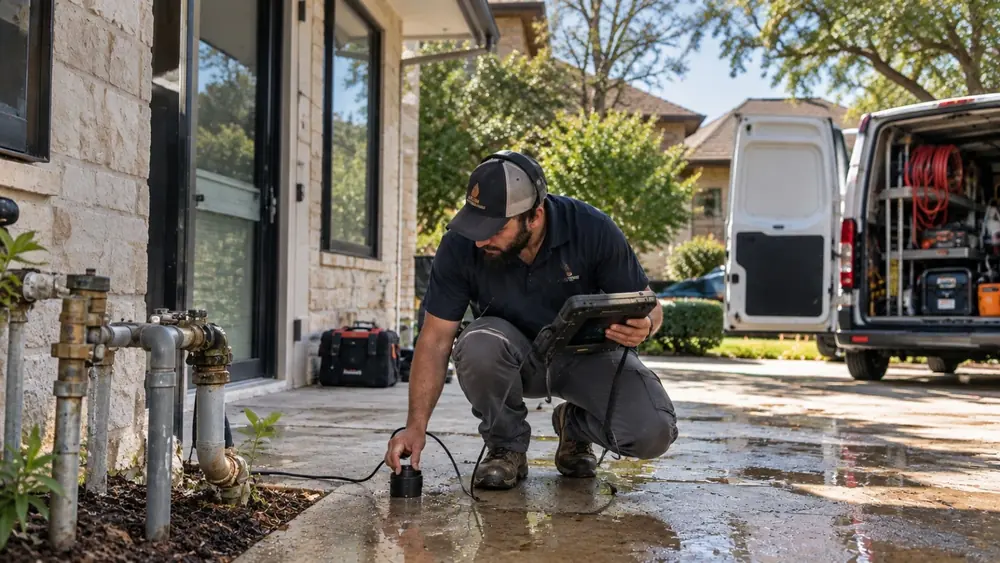
Providers walk the property, test each irrigation zone, and use electronic listening equipment along the buried line to find where pressurized water is escaping. If the line passes beneath concrete, planters or trees, they may pressure test it in sections. Where sound alone is unclear, tracer gas can confirm the point. All of these tools are explained under leak detection methods.
Once located, repair options for a yard line range from a small excavation and spot repair to replacing the run or lining it without digging a trench. See leak repair and trenchless pipe lining.
Cost considerations
Cost depends on property size, the number of irrigation zones, how long the service line is, and what lies above it, such as turf, patios or driveways. Providers price detection and repair separately, so ask about both. A line that ends up being a utility-side leak is not yours to repair, so confirm the meter location before authorizing any work.
Yard leaks across Whittier
Properties with larger yards have more irrigation and more buried line to inspect. That includes East Whittier, where larger homes and yards are common, the larger lots of Mar Vista Heights, and the sloped lots of College Hills, where a yard leak can saturate a hillside. For help, leak detection in Whittier providers can sort a meter-side from a house-side problem on the first call.
Frequently asked questions
How do I tell if a leak is coming from a sprinkler valve?
Turn the controller off and check whether the meter still moves with the house off. If it moves with irrigation off, the leak is elsewhere. If the meter only runs when a zone is on, test zones one at a time. A valve that weeps usually leaves wet ground around the valve box.
Who is responsible for a leak outside the meter?
In general the property owner is responsible for the line on the house side of the water meter and the utility for the main on the street side, but this varies. Confirm with your water utility before authorizing a repair.
Can a small outside leak damage a foundation or stucco?
Yes. Water that pools against a foundation or runs behind stucco can soften soil and damage materials over time. Correct the source and the drainage.
Why is my water bill high in summer?
Irrigation raises summer use, but a bill far above your usual summer level can mean a leak. Compare the meter with irrigation off to find out.
Can a buried line be repaired without trenching?
Sometimes. Depending on the pipe's condition and layout, a provider may propose a small spot excavation, a reroute, or pipe lining. A provider can say which fits your line after locating the leak.
Related services
- High Water Bills & Fixture TestsMeter checks, toilet and fixture leak tests, and water loss audits to explain a bill.
- Pool & Spa Leak DetectionWater level dropping faster than it should? Separate evaporation from a real leak.
- Leak Repair, Pipe Lining & Smart ValvesTargeted repair after detection, trenchless pipe lining, and smart shutoff valves.
- Sewer Video InspectionA camera on a flexible cable shows cracks, roots, offsets and blockages in the sewer line.